A Short History of the Mormons
The history of the Mormons, or members of The Church of Jesus Christ of Latter-day Saints (LDS Church), began in the early 19th century.
The movement began with Joseph Smith, who claimed to have received visions from God. In 1820, he reported a vision in which he saw God and Jesus Christ. In 1823, an angel named Moroni guided him to golden plates, which he translated into the Book of Mormon, published in 1830. It was introduced as another testament of Jesus Christ, alongside the Bible.
The church attracted followers, particularly in New York and Ohio. However, it also faced significant opposition due to its beliefs and practices, including communal living and later, polygamy.
In the early 1830s, Mormons moved to Missouri, where tensions grew, leading to violence and expulsion. They then settled in Nauvoo, Illinois, where they built a thriving community and the Nauvoo Temple. Joseph Smith was killed by a mob in 1844, leading to a leadership crisis.
After Smith’s death, Brigham Young emerged as the new leader. In 1847, he led a large group of Mormons to the Salt Lake Valley in present-day Utah, seeking religious freedom and a place to establish their community.
The Utah Territory was established, and the Mormons developed agriculture and industry in the region. They faced challenges, including conflicts with the U.S. government and tensions with non-Mormon settlers.
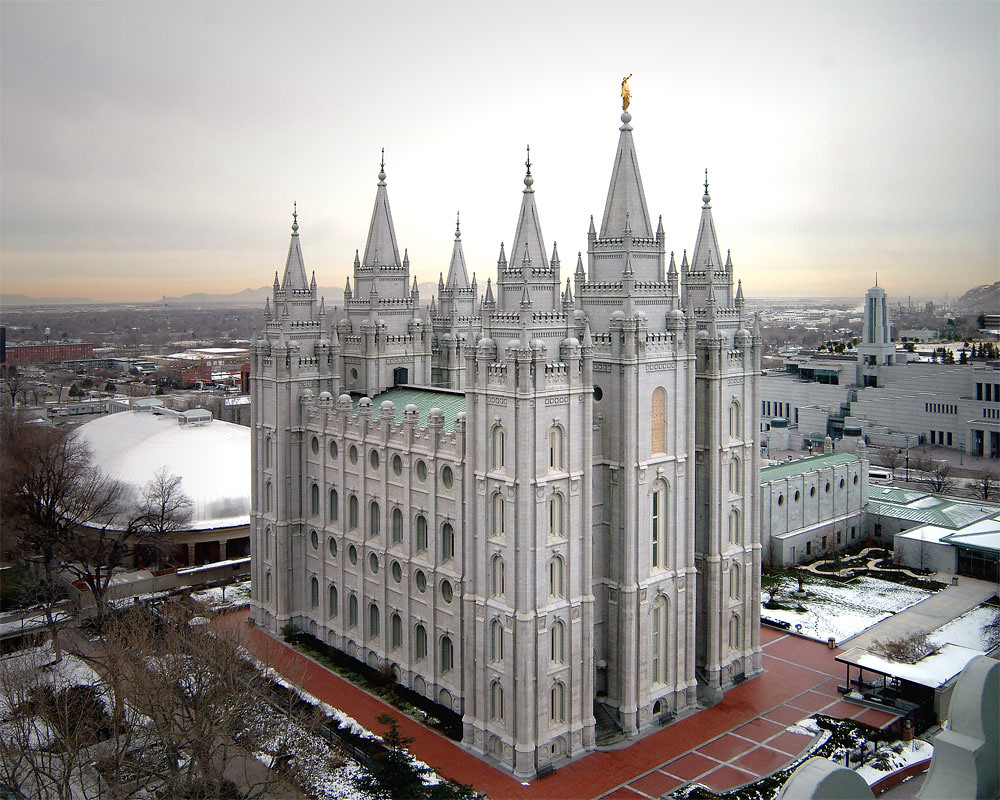
Once settled in Utah, Brigham Young ordered the construction of numerous temples, including the Salt Lake Temple. He also formalized the prohibition of black men attaining priesthood and directed the Mormon Reformation. A supporter of education, Young worked to establish the learning institutions that would later become the University of Utah and Brigham Young University.
Young founded Salt Lake City and was appointed Utah’s first territorial governor by President Millard Fillmore in 1850. As governor, Young allowed polygamy, supported slavery and its expansion into Utah, and led the efforts to legalize and regulate slavery in the 1852 Act in Relation to Service, based on his beliefs on slavery. He exerted considerable power over the territory through his theocratic political system, theodemocracy.
After President James Buchanan appointed a new governor of the territory, Young declared martial law and re-activated the Nauvoo Legion, beginning the Utah War. During the conflict, the Utah Territorial Militia committed a series of attacks that resulted in the mass murder of at least 120 members of the Baker–Fancher immigrant wagon train, known as the Mountain Meadows Massacre. The following month, the Aiken massacre was perpetrated on Young’s orders.
In 1858, the war ended when Young surrendered; agreeing to resign as governor and allow federal troops to enter the Utah Territory in exchange for a pardon granted to Mormon settlers from President Buchanan.

A polygamist, Young had 56 wives and 57 children. His teachings are contained in the 19 volumes of transcribed and edited sermons in the Journal of Discourses. His legacy and impact are seen throughout the American West, including numerous memorials, temples, and schools named in his honor. In 2016, Young was estimated to have around 30,000 descendants.
Polygamy became a controversial practice among Mormons. The U.S. government passed laws to suppress it, leading to legal battles and societal ostracism. In 1890, church leader Wilford Woodruff issued the Manifesto, officially ending the practice of polygamy.
The church continued to grow throughout the 20th century, focusing on missionary work and community service. It established a significant presence worldwide.
The LDS Church is now a global organization with millions of members. It emphasizes family, community service, and education. The church has also worked to improve its public image and engage in interfaith dialogue.
Destination: Colorado and Utah