
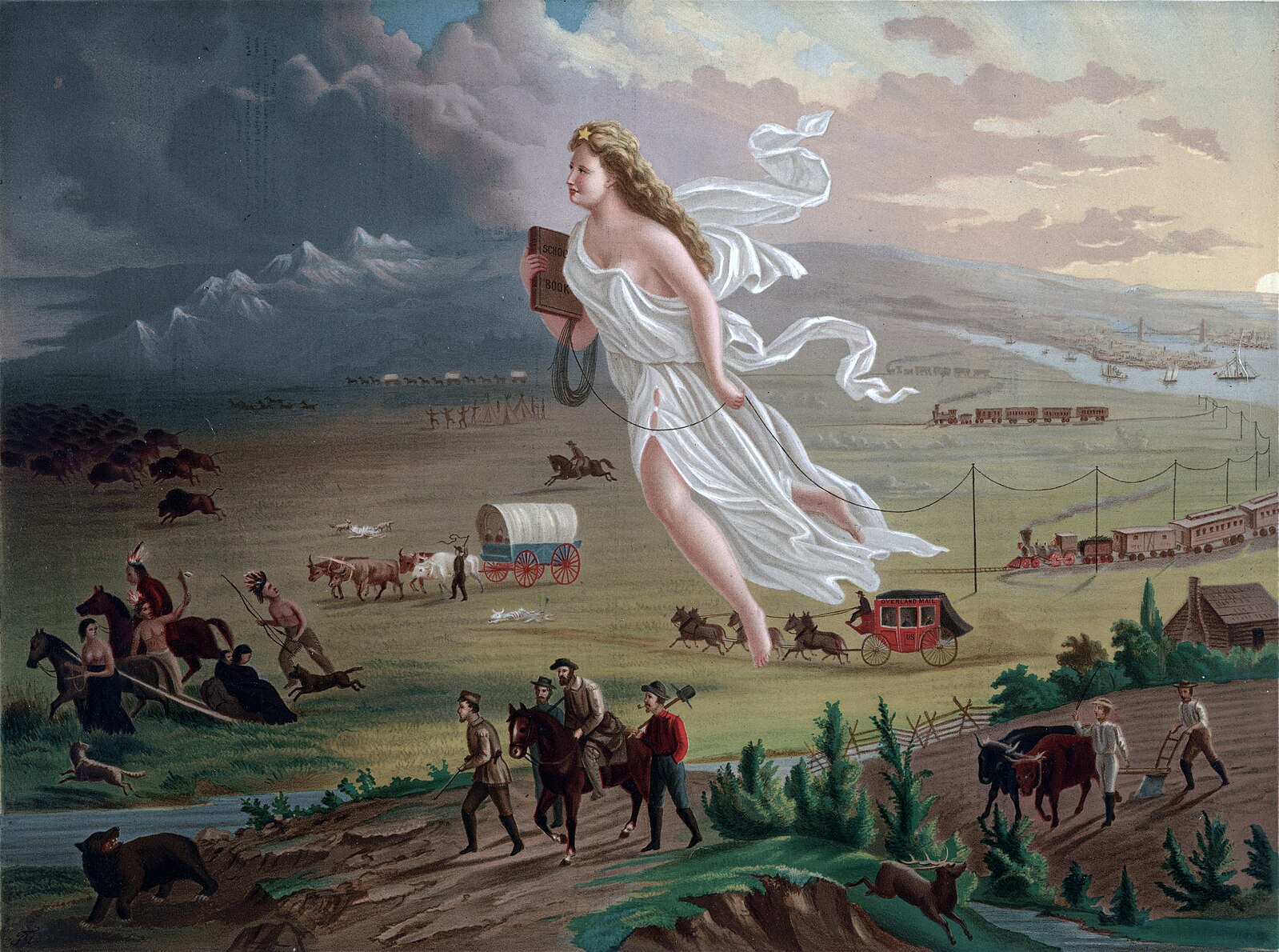
Manifest Destiny: The American Way?
Manifest destiny was the expansionist belief in the 19th-century United States that American settlers were destined to expand westward across North America, and that this belief was both obvious (“manifest”) and certain (“destiny”).
The belief is rooted in American exceptionalism, romantic nationalism, and white nationalism, implying the inevitable spread of republicanism and the American way. It is one of the earliest expressions of American imperialism.
American Progress (1872) by John Gast is an allegorical representation of the modernization of the new west. Columbia, a personification of the United States, is shown leading civilization westward with the American settlers. She is shown bringing light from east to west, stringing telegraph wire, holding a school book, and highlighting different stages of economic activity and evolving forms of transportation.On the left, Indigenous Americans are displaced from their ancestral homeland.
According to historian William Earl Weeks, there were three basic tenets behind the concept
- The assumption of the unique moral virtue of the United States.
- The assertion of its mission to redeem the world by the spread of republican government and more generally the “American way of life”.
- The faith in the nation’s divinely ordained destiny to succeed in this mission.
Manifest destiny remained heavily divisive in politics, causing constant conflict with regard to slavery in these new states and territories.It is also associated with the expansion of European settlers onto the territories of Indigenous Americans[m and the annexation of lands to the west of the United States borders at the time on the continent. The concept became one of several major campaign issues during the 1844 presidential election, where the Democratic Party won and the phrase “Manifest Destiny” was coined within a year.
The concept of manifest destiny was used by Democrats to justify the 1846 Oregon boundary dispute and the 1845 annexation of Texas as a slave state, culminating in the 1846 Mexican–American War. In contrast, the large majority of Whigs and prominent Republicans(such as Abraham Lincoln and Ulysses S. Grant) rejected the concept and campaigned against these actions.By 1843, former U.S. president John Quincy Adams, originally a major supporter of the concept underlying manifest destiny, had changed his mind and repudiated expansionism because it meant the expansion of slavery in Texas.Ulysses S. Grant served in and condemned the Mexican–American War, declaring it “one of the most unjust ever waged by a stronger against a weaker nation”.
After the American Civil War, the U.S. acquired Alaska in 1867. In the 1890s, Republican president William McKinley annexed Hawaii, the Philippines, Puerto Rico, Guam, and American Samoa. The 1898 Spanish–American War was controversial and imperialism became a major issue in the 1900 United States presidential election. Historian Daniel Walker Howesummarizes that “American imperialism did not represent an American consensus; it provoked bitter dissent within the national polity”.
A possible influence is racial predominance, namely the idea that the American Anglo-Saxon race was “separate, innately superior” and “destined to bring good government, commercial prosperity and Christianity to the American continents and the world”. Author Reginald Horsman wrote in 1981, this view also held that “inferior races were doomed to subordinate status or extinction.” and that this was used to justify “the enslavement of the blacks and the expulsion and possible extermination of the Indians”
The origin of the first theme, later known as American exceptionalism, was often traced to America’s Puritan heritage, particularly John Winthrop’s famous “City upon a Hill” sermon of 1630, in which he called for the establishment of a virtuous community that would be a shining example to the Old World. In his influential 1776 pamphlet Common Sense, Thomas Paine echoed this notion, arguing that the American Revolution provided an opportunity to create a new, better society:
We have it in our power to begin the world over again. A situation, similar to the present, hath not happened since the days of Noah until now. The birthday of a new world is at hand…
Many Americans agreed with Paine, and came to believe that the United States’ virtue was a result of its special experiment in freedom and democracy. Thomas Jefferson, in a letter to James Monroe, wrote, “it is impossible not to look forward to distant times when our rapid multiplication will expand itself beyond those limits, and cover the whole northern, if not the southern continent.”To Americans in the decades that followed their proclaimed freedom for mankind, embodied in the Declaration of Independence, could only be described as the inauguration of “a new time scale” because the world would look back and define history as events that took place before, and after, the Declaration of Independence. It followed that Americans owed to the world an obligation to expand and preserve these beliefs.
The second theme’s origination is less precise. A popular expression of America’s mission was elaborated by President Abraham Lincoln’s description in his December 1, 1862, message to Congress. He described the United States as “the last, best hope of Earth”. The “mission” of the United States was further elaborated during Lincoln’s Gettysburg Address, in which he interpreted the American Civil War as a struggle to determine if any nation with democratic ideals could survive; this has been called by historian Robert Johannsen “the most enduring statement of America’s Manifest Destiny and mission”.
The third theme can be viewed as a natural outgrowth of the belief that God had a direct influence in the foundation and further actions of the United States. Political scientist and historian Clinton Rossiter described this view as summing “that God, at the proper stage in the march of history, called forth certain hardy souls from the old and privilege-ridden nations … and that in bestowing his grace He also bestowed a peculiar responsibility”. Americans presupposed that they were not only divinely elected to maintain the North American continent, but also to “spread abroad the fundamental principles stated in the Bill of Rights”.In many cases this meant neighboring colonial holdings and countries were seen as obstacles rather than the destiny God had provided the United States.
Article courtesy of Wikipedia
Destination: United States