Hogmanay: Celebrating New Year in Scotland
Hogmanay is the Scots word for the last day of the old year and is synonymous with the celebration of the New Year in the Scottish manner.
It is normally followed by further celebration on the morning of New Year’s Day (1 January) and, in some cases, 2 January—a Scottish bank holiday.
Customs vary throughout Scotland and usually include gift-giving and visiting the homes of friends and neighbours, with particular attention given to the first-foot, the first guest of the new year.
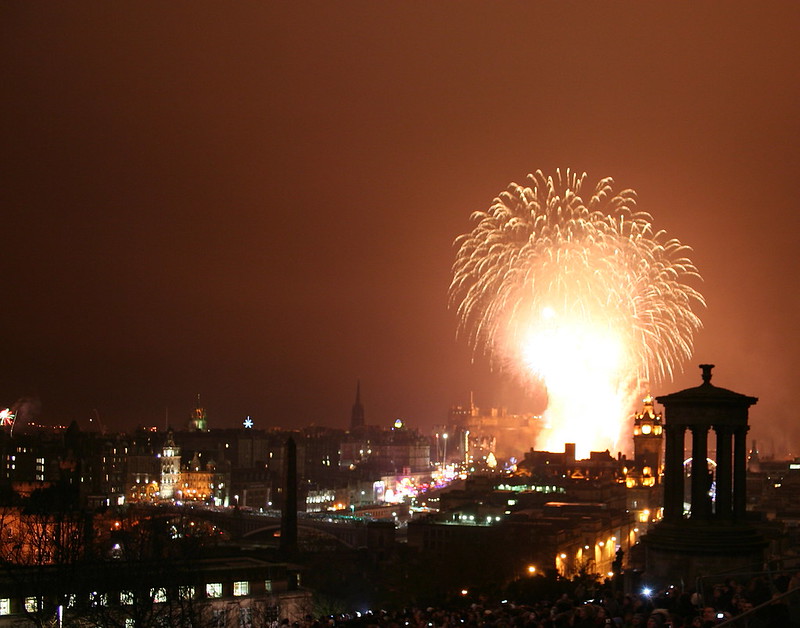
Celebrations also include reflection ; late-night partying; family gatherings; feasting; gift exchanges; fireworks; and social gatherings, involving dancing , eating and drinking.
It is speculated that the roots of Hogmanay may reach back to the celebration of the winter solstice among the Norse, as well as incorporating customs from the Gaelic celebration of Samhain.
The Vikings celebrated Yule, which later contributed to the Twelve Days of Christmas, or the “Daft Days” as they were sometimes called in Scotland. Christmas was not celebrated as a festival, and Hogmanay was the more traditional celebration in Scotland.This may have been a result of the Protestant Reformation after which Christmas was seen as “too Papist”.
There are many customs, both national and local, associated with Hogmanay. The most widespread national custom is the practice of first-footing, which starts immediately after midnight. This involves being the first person to cross the threshold of a friend or neighbour and often involves the giving of symbolic gifts such as salt (less common today), coal, shortbread, whisky, and black bun (a rich fruit cake), intended to bring different kinds of luck to the householder.
Food and drink (as the gifts) are then given to the guests. This may go on throughout the early morning hours and into the next day (although modern days see people visiting houses well into the middle of January). The first-foot is supposed to set the luck for the rest of the year. Traditionally, tall, dark-haired men are preferred as the first-foot.
The Hogmanay custom of singing “Auld Lang Syne” has become common in many countries. “Auld Lang Syne” is a Scots poem by Robert Burns, based on traditional and other earlier sources. It is common to sing this in a circle of linked arms crossed over one another as the clock strikes midnight for New Year’s Day. However, it is only intended that participants link arms at the beginning of the final verse before rushing into the centre as a group.
Hogmanay food centers on hearty, traditional Scottish fare like Haggis, Neeps & Tatties (sheep’s pluck with oats, served with mashed turnips/parsnips and potatoes) for dinner, and sweets such as buttery Shortbread, spiced Black Bun (a fruitcake in pastry), and rich Clootie Dumpling (spotted pudding) for sharing and first-footing gifts. Festive drinks include Scotch whisky, champagne, and homemade cordials, all for good fortune in the New Year.
Destination: Scotland