Rupert Brooke: War Poet
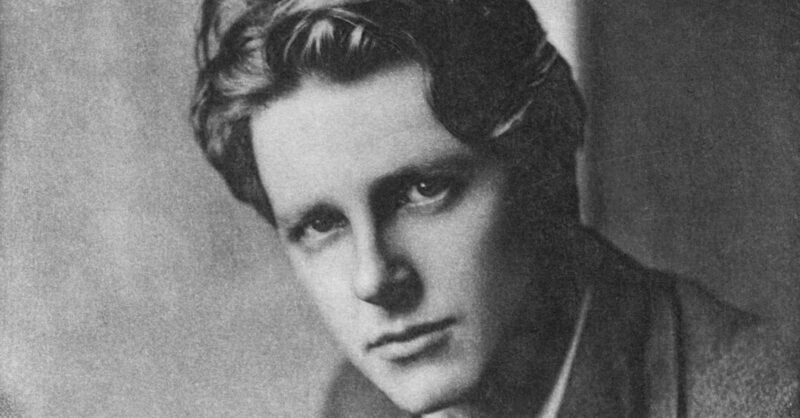
Rupert Brooke (3 August 1887 – 23 April 1915) was an English poet celebrated for his idealistic war sonnets written during the opening months of the First World War.
Known for his striking good looks and youthful charisma, Irish poet W. B. Yeats famously described him as “the handsomest young man in England”. His early death at age 27 cemented his legacy as a tragic symbol of a lost golden generation.
Born in Rugby, Warwickshire, Brooke was the son of a school housemaster. He excelled in both academics and sports—specifically cricket and football.
Pop He attended King’s College, Cambridge, where he served as president of the University Fabian Society and was elected a Fellow.
He associated closely with the Bloomsbury Group (including Virginia Woolf) and led a nature-loving literary clique known as the “Neo-Pagans”.
After travelling across North America and the South Seas, when World War I broke out in August 1914, Brooke immediately enlisted in the Royal Naval Division. He wrote his most famous work, a sequence of five sonnets titled 1914, later that year.
His defining masterpiece “ The Soldier”begins with the famous line, “If I should die, think only this of me: That there’s some corner of a foreign field That is for ever England.”
His work captured an innocent, deeply patriotic, and romanticised view of sacrifice. Because he died early in the war, his poetry never reflected the brutal, disillusioned realities of trench warfare later captured by poets like Wilfred Owen and Siegfried Sassoon.
Brooke never saw combat in Gallipoli. While sailing with the British Mediterranean Expeditionary Force, he contracted sepsis (blood poisoning) from an infected mosquito bite.
He died on a French hospital ship on 23 April 1915—St George’s Day. He was buried in an isolated olive grove on the Greek island of Skyros.
His poem “The Soldier” was read aloud at St Paul’s Cathedral on Easter Sunday just weeks before his death. Following his passing, Winston Churchill wrote a glowing obituary in The Times, elevating Brooke into a national icon of chivalry and patriotic duty.
Destination: England