
The Afgan Empire
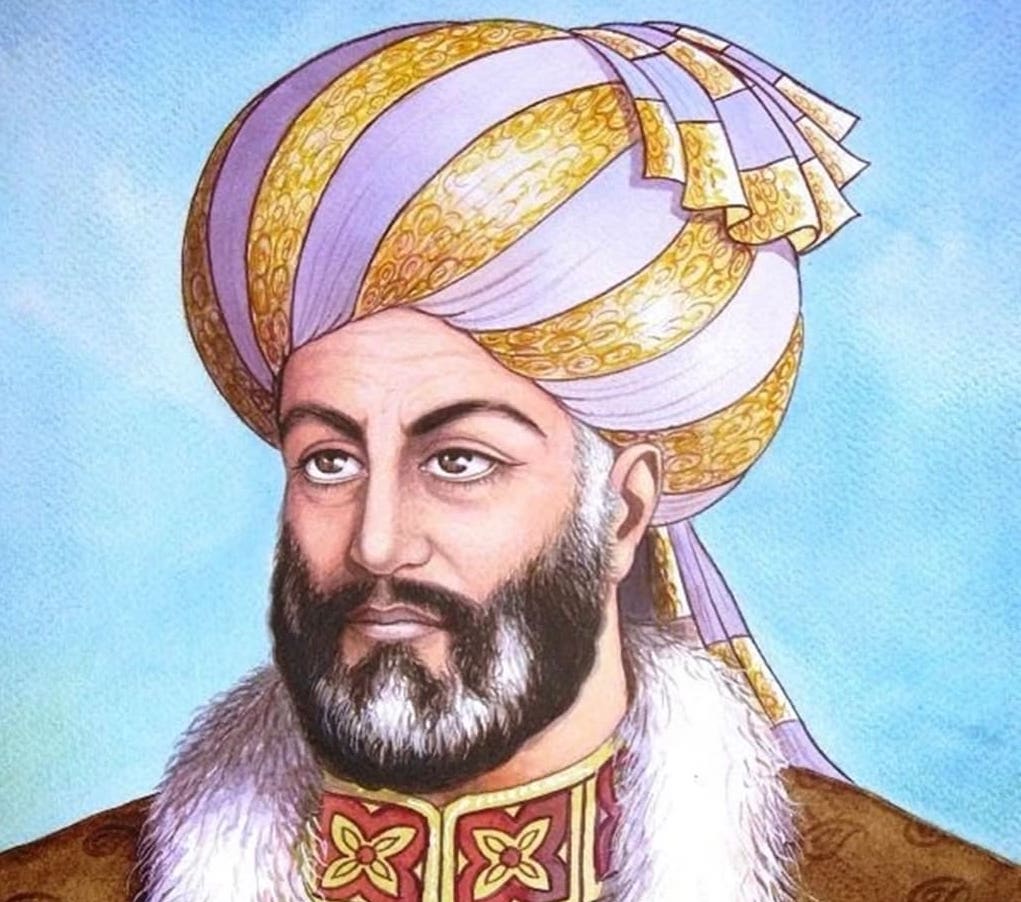
The Afghan Empire was established in the mid-18th century by Ahmad Shah Durrani, also known as Ahmad Shah.. He is credited with unifying various Pashtun tribes and forming a significant state that encompassed modern-day Afghanistan and parts of Pakistan, Iran, and India.
Ahmad Shah Durrani’s reign lasted for 35 years from 1747 to 1 and 772 marked the peak of the empire, characterized by military campaigns, territorial expansion, and the establishment of a centralized authority. The empire served as a crucial power in the region, especially in the context of the declining Mughal Empire and the rising influence of the British and Russian empires in the 19th century.
After its sacking by the Persian king , Nader Shah, Delhi would be sacked again by Ahmad Shah’s Afgans, continuing a pattern of rape and pillage of the declining Mughal Empire.
Afghan dynasties had long been in competition with the Mughals in the north west of the empire – what is today Pakistan and Afghanistan .Kabul had been the Mughal summer capital for two centuries.
Following the death of the Iranian despot Nader Shah, his eastern domains were taken over by Ahmad Shah Durrani, who formed the Afgan Durrani Empire. Ahmad had been a loyal lieutenant to Nader Shah in his Indian campaigns and was present when he was assassinated.
Ahmad Shah centered his power base in Kandahar.The Mughals would lose numerous territories including Kashmir, Punjab, and Sindh. as Ahmad Shah carried out no fewer than nine invasions , and 15 campaigns over a 20 year period.
Ahmad Shah also extended his Afghan empire to control other regions Outside of India, he campaigned in Khorasan and Afghan Turkestan, subjugating the Afsharids, crossing swords with the Khanate of Bukhara, and even encounters with Qing China.
Invited to invade India in 1756 by the weakened Mughals as a foil against resurgent Hindu Marathas ,Ahmad Shah overran the Punjab with an army of 80,000 men. His victories culminated in the biggest war in the region in the 18th century at the second Battle of Paripat.
It lasted for several days and involved over 125,000 troops;.It is believed that 70,000 troops were killed in the fighting,,About 40,000 Maratha prisoners were collectively slaughtered on the day after the battle. as the Afghans built victory mounds of severed heads.
After defeating the Marathas, Ahmad Shah turned on the Mughals themselves, reached Delhi and soon forced the Mughal emperor Alamgir II to submit. The subsequent sack of Delhi, yielded immense wealth.It marked a significant blow to the already weakened Mughal Empire.
Many of the inhabitants of the city had already fled or hidden, the streets were completely deserted. As people barricaded themselves in their houses., bazaars were sacked as soldiers extracted tribute.
Ahmad Shah then ordered all Hindus to wear distinctive marks on their head,as well as forbidding non-Muslims from wearing the turban. Mughal nobility suspected of concealing valuables were subjected to torture, including foot whipping. Thousands died or were crippled as a result, while others resorted to suicide.
It’s been estimated that the Afghans seized loot worth 300 million rupees loaded onto some 28,000 elephants, mules and horses.
Ahmad Shah has been described as the “greatest general of Asia of his time”, as well as one of the greatest conquerors in Asian history.
The Durrani Empire faced challenges from both internal factions and external forces. After Ahmad Shah’s death, the empire struggled with succession disputes and regional power struggles, leading to its gradual decline. By the 19th century, Afghanistan became a focal point in the “Great Game” between British and Russian interests in Central Asia.
Despite its decline, the legacy of the Afghan Empire endures in the national identity of Afghanistan and the Pashtun people. The empire is often remembered for its role in shaping the political landscape of the region and its impact on Afghan culture and society.
Destinations; Afganistan, Pakistan, Iran, India, Uzbekistan