The Irish Potato Famine
The Irish Potato Famine, was a period of mass starvation and disease in Ireland from 1845 to 1852. It constituted a historical social crisis and had a major impact on Irish society and history.
The most severely affected areas were in the western and southern parts of Ireland—where the Irish language was dominant. Here the famine was known in Irish as an Drochshaol which literally translates to “the bad life” and loosely translates to “the hard times”.
The worst year of the famine was 1847, which became known as “Black ’47”. The population of Ireland on the eve of the famine was about 8.5 million; by 1901, it was just 4.4 million.About one million people died and over one million more fled the country,causing the country’s population to fall by 20–25% between 1841 and 1871, with some towns’ populations falling by as much as two thirds Between 1845 and 1855, at least 2.1 million people left Ireland, one of the greatest exoduses from a single island in history.
The cause of the famine was the infection of potato crops by blight throughout Europe. Impact on food supply by blight infection caused 100,000 deaths outside Ireland, and influenced much of the unrest that culminated in European Revolutions of 1848.Longer-term reasons for the massive impact of this particular famine included the system of absentee landlordism and single-crop dependence
Large amounts of food were exported from Ireland during the famine and the refusal of Britain , its colonial master , to bar such exports, as had been done on previous occasions, was an immediate and continuing source of controversy, contributing to anti-British sentiment and the campaign for independence.
The famine was a defining moment in the history of Ireland.The famine and its effects permanently changed the island’s demographic, political, and cultural landscape, producing an estimated 2 million refugees and spurring a century-long population decline.
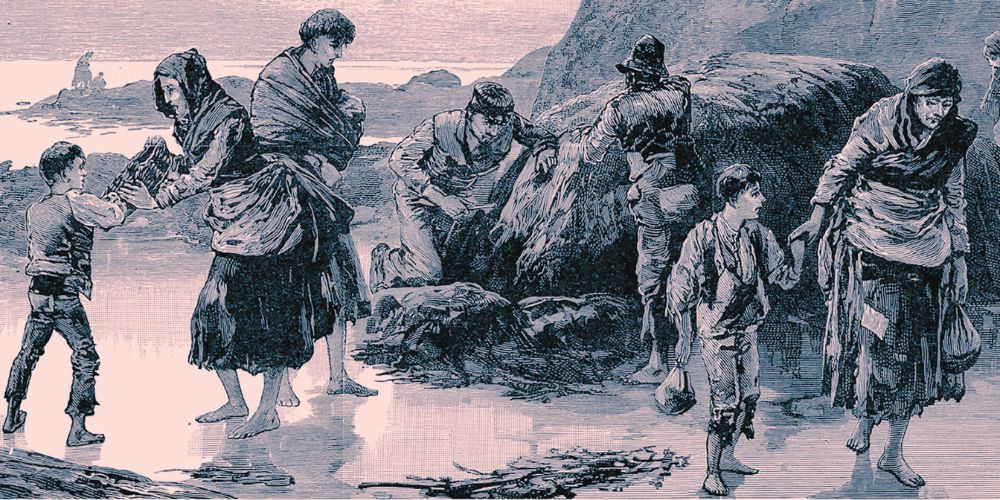
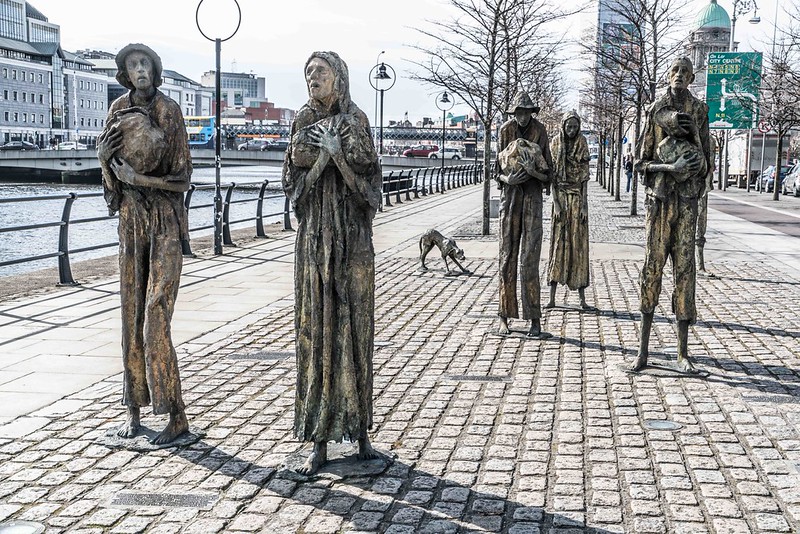
For both the native Irish and those in the resulting diaspora, the famine entered folk memory.The strained relations between many Irish people and the then ruling British government worsened further because of the famine, heightening ethnic and sectarian tensions and boosting nationalism and republicanism both in Ireland and among Irish emigrants around the world.
Background
Ireland was brought into the United Kingdom in January 1801 following the passage of the Acts of Union. But real power lay in London Between 1832 and 1859, 70% of Irish representatives were landowners or the sons of landowners.
In the 40 years that followed the union, successive British governments grappled with the problems of governing a country which had, as Benjamin Disraeli stated in 1844, “a starving population, an absentee aristocracy, an alien established Protestant church, and in addition, the weakest executive in the world”.One historian calculated that, between 1801 and 1845, there had been 114 commissions and that “without exception their findings prophesied disaster; Ireland was on the verge of starvation, her population rapidly increasing, three-quarters of her labourers unemployed, housing conditions appalling and the standard of living unbelievably low”
A majority of Catholics, who constituted 80% of the Irish population, lived in conditions of poverty and insecurity. At the top of the social hierarchy was the Ascendancy class, composed of English and Anglo-Irish families who owned most of the land and held more or less unchecked power over their tenants. Some of their estates were vast; for example, the Earl of Lucan owned more than 60,000 acres .Many of these landowners lived in England and functioned as absentee landlords. The rent revenue was mostly sent to England.
Some landlords visited their property only once or twice in a lifetime, if ever. The rents from Ireland were generally spent elsewhere; an estimated £6,000,000 was remitted out of Ireland in 1842.
The Potato Dependency
The potato was first introduced in Ireland as a garden crop of the gentry. By the late 17th century, it had become widespread as a supplementary food, but the main Irish diet, at that time, was still based on butter, milk, and grain products.
The Irish economy grew between 1760 and 1815 due to infrastructure expansion and the Napoleonic Wars (1805–1815), which had increased the demand for food in Britain. Tillage increased to such an extent that there was only a small amount of land available to small farmers to feed themselves. The potato was adopted as a primary food source because of its quick growth in a comparatively small space.By 1800, the potato had become a staple food for one in three Irish people,especially in winter. It eventually became a staple year-round for farmers. A disproportionate share of the potatoes grown in Ireland were the Irish Lumper,creating a lack of genetic variability among potato plants, which increased vulnerability to disease.
Destination: Ireland