The American who saved The Alhambra
The American author Washington Irving, lived inside the Moorish palace in Granada and wrote Tales of the Alhambra. He is credited with making the making it famous and even saving this great wonder of the ancient would from ruin.
Published in 1832, this celebrated collection of essays, verbal sketches, and local folklore was inspired by his residency at the ancient Moorish fortress.
Working as an American diplomat in Spain, Irving spent roughly three months living directly inside the palace grounds during the summer of 1829.
He was granted special access by the governor of the palace due to his celebrity status as a writer.
Alongside his 17-year-old local guide, Mateo Ximenes, Irving explored the neglected, crumbling fortress. He spent his days collecting the rich oral histories, romantic myths, and ghost stories shared by the colorful local residents who were squatting in the ruins at the time.
At the time of his visit, the Alhambra was largely forgotten, decaying, and vandalized. To combat the graffiti left by travelers, Irving created the palace’s very first official guest book to preserve the walls.
Irving’s descriptions painted a dreamy, mysterious image of Andalusia that single-handedly kickstarted international romantic tourism to Southern Spain.

Today, he is deeply revered in Granada: The specific apartments where he stayed inside the Nasrid Palaces are officially named the Washington Irving Rooms and feature a commemorative plaque.
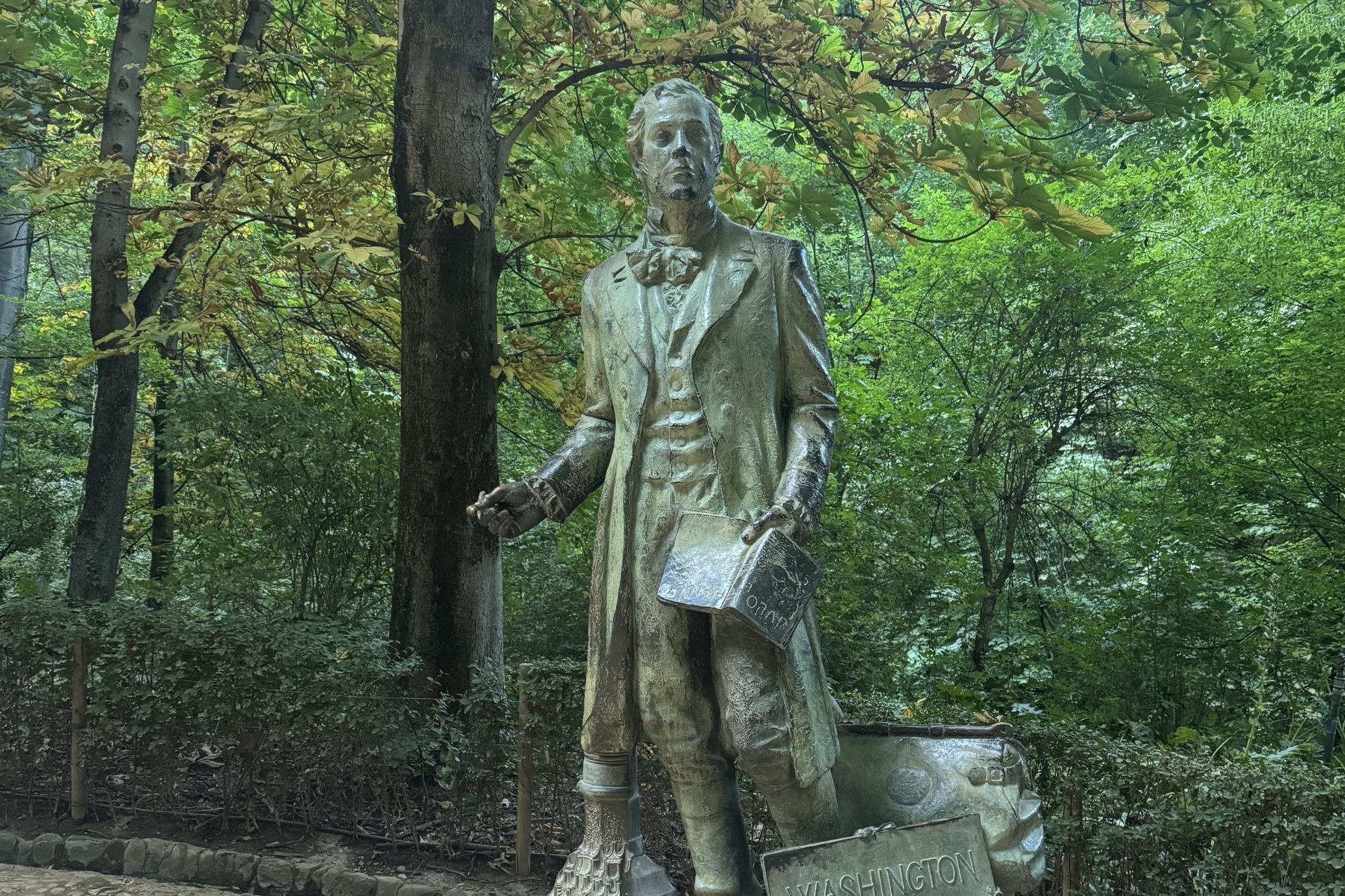
A bronze statue of the author stands in the gardens just outside the palace walls, affectionately bearing the inscription “Son of the Alhambra”.

Irving wrote the short stories “Rip Van Winkle” (1819) and “The Legend of Sleepy Hollow” (1820), both of which appear in his collection The Sketch Book of Geoffrey Crayon, Gent. His historical works include biographies of Oliver Goldsmith, Muhammad, and George Washington, as well as several histories of 15th-century Spain that deal with subjects such as the Alhambra, Christopher Columbus, and the Moors.
Irving was one of the first American writers to earn acclaim in Europe, and he encouraged other American authors such as Nathaniel Hawthorne, Henry Wadsworth Longfellow, Herman Melville, and Edgar Allan Poe. He was also admired by some British writers, including Lord Byron, Thomas Campbell, Charles Dickens, Mary Shelley, Francis Jeffrey, and Walter Scott.
He advocated for writing as a legitimate profession and argued for stronger laws to protect American writers from copyright infringement.
Destinations: Spain / United States