
The Bayeux Tapestry
The Bayeux Tapestry is an embroidered cloth nearly 70 metres (230 feet) long and 50 centimetres (20 inches) tall that depicts the events leading up to the Norman Conquest of England in 1066, led by William, Duke of Normandy, known as William the Conqueror, challenging Harold II, King of England, and culminating in the Battle of Hastings.
It is thought to date to the 11th century, within a few years of the battle. Now widely accepted to have been made in England, perhaps as a gift for William, it tells the story from the point of view of the conquering Normans and for centuries has been preserved in Normandy.
The cloth consists of 58 scenes, many with Latin captions embroidered on linen with coloured woollen yarns. It is likely that it was commissioned by Bishop Odo of Bayeux, William’s maternal half-brother, and made for him in England in the 1070s.
In 1729, the hanging was rediscovered by scholars at a time when it was being displayed annually in Bayeux Cathedral. The tapestry is now exhibited at the Musée de la Tapisserie de Bayeux in Bayeux, Normandy, in France.
The designs on the Bayeux Tapestry are embroidered rather than in a tapestry weave, so it does not meet narrower definitions of a tapestry. It is a rare example of secular Romanesque art. Tapestries adorned both churches and wealthy houses in medieval Western Europe, though the Bayeux Tapestry is exceptionally large. The background is not embroidered, providing a large, clear field of cloth which allows the figures and decorative elements to stand out very clearly.
The key scenes of the Norman conquest depicted in the tapestry are:
Prelude to Conflict (1064–1066): The narrative begins with Harold, Earl of Wessex, traveling to Normandy on a mission for King Edward the Confessor. It depicts Harold being captured, freed by Guy of Ponthieu, and meeting Duke William of Normandy. A critical scene shows Harold swearing a sacred oath to support William’s claim to the English throne.
The Death of Edward and Coronation of Harold: Following a return to England, the scene shifts to the deathbed of Edward the Confessor and his subsequent funeral procession to Westminster Abbey. Harold is then shown being crowned King of England.
Preparations for Invasion: Upon hearing of Harold’s coronation, William orders the construction of a fleet. Scenes depict the felling of trees, building of longships, and loading of arms, supplies, and horses.
The Norman Invasion: The Norman fleet crosses the English Channel and lands at Pevensey, followed by the troops foraging for food and constructing a castle at Hastings.
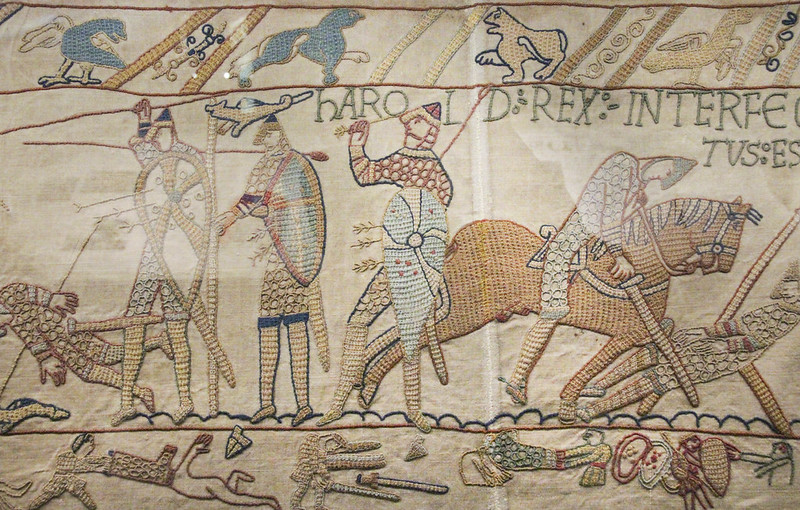
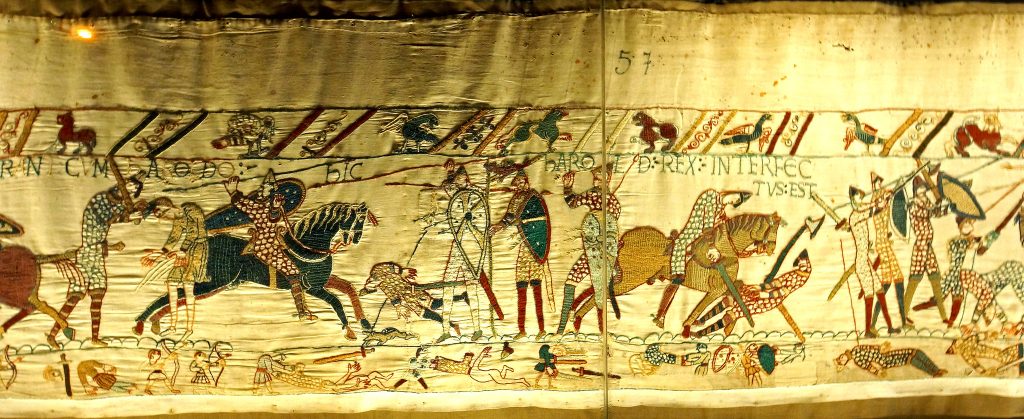
The Battle of Hastings (14 October 1066):The climax depicts intense battle scenes, including the Norman cavalry engaging the English infantry, the death of Harold’s brothers (Gyrth and Leofwine), and Bishop Odo rallying the troops.
The Death of Harold and English Defeat:The tapestry concludes with the death of Harold (often interpreted as the figure with an arrow in his eye) and the retreat of the English army.