Texas and the Era of the Long Distance Cattle Drive
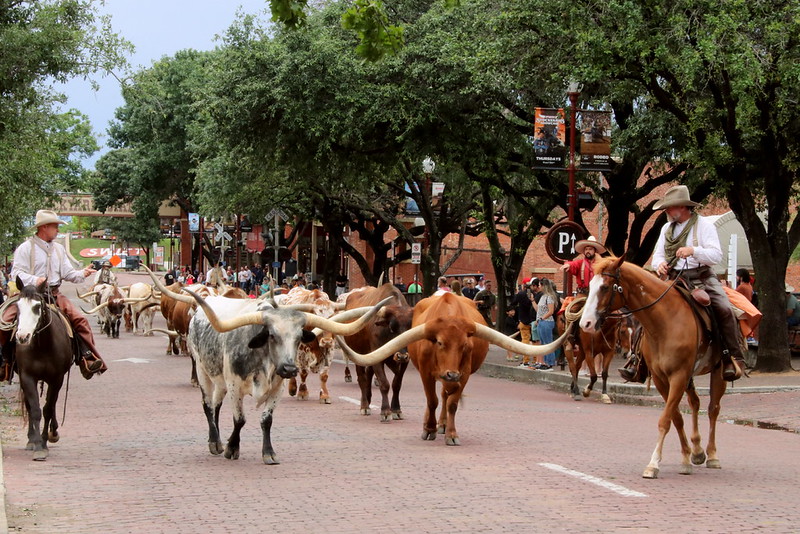
The Texas cattle industry began with Spanish explorers in the 15th century, but exploded in the 1800s with the when the iconic Texas Longhorn roamed vast open ranges. Following the Texas Revolution in 1836, settlers claimed, branded, and drove wild herds to markets. Despite disease issues like Texas fever and growing opposition to early drives, the industry established Texas as a dominant agricultural powerhouse.
The 15th-century arrival of Spanish cattle and the vaquero ( Mexican cowboy) tradition formed the foundation of the Texas cattle industry.
After Texan independence in 1836 abandoned Mexican cattle were rounded up by Texans, creating massive, wild herds that were ideal for long-distance drives due to their hardiness.
Initial drives went to New Orleans (1836) and later Missouri (1840s) via the Shawnee Trail, though disease (Texas fever) carried by ticks on Longhorns caused conflict with local farmers
As farming increased in Missouri and Kansas in the 1850s, cattlemen faced legal hurdles and violent opposition, forcing them to seek alternative routes and markets.
Early ranching focused on hides and tallow, but the 1850s brought increased demand for beef, boosting the economic value of the herds.
Cattle drives were a major economic activity in the 19th and early 20th century American West, particularly between 1850s and 1910s.
In this period, 27 million cattle were driven from Texas to railheads in Kansas, for shipment to stockyards in St. Louis and points east, and direct to Chicago.
The long distances covered, the need for periodic rests by riders and animals, and the establishment of railheads led to the development of “cow towns” across the frontier.
Four Texas-based cattle trails – the Shawnee Trail System, the Goodnight Trail System, the Eastern/Chisholm Trail System, and The Western Trail System – were used to drive cattle north during the forty-year period between 1846 and 1886.”
Cattle drives represented a compromise between the desire to get cattle to market as quickly as possible and the need to maintain the animals at a marketable weight. While cattle could be driven as far as 25 miles (40 km) in a single day, they would lose so much weight that they would be hard to sell when they reached the end of the trail.
Usually they were taken shorter distances each day, allowed periods to rest and graze both at midday and at night. On average, a herd could maintain a healthy weight moving about 15 miles (24 km) per day. Such a pace meant that it would take as long as two months to travel from a home ranch to a railhead. The Chisholm Trail, for example, was 1,000 miles (1,600 km) long.
On average, a single herd of cattle on a long drive (for example, Texas to Kansas railheads) numbered about 3,000 head. To herd the cattle, a crew of at least 10 cowboys was needed, with three horses per cowboy. Cowboys worked in shifts to watch the cattle 24 hours a day, herding them in the proper direction in the daytime and watching them at night to prevent stampedes and deter theft.
The crew also included a cook, who drove a chuck wagon, usually pulled by oxen, and a horse wrangler to take charge of the remuda(spare horses). The wrangler on a cattle drive was often a very young cowboy or one of lower social status, but the cook was a particularly well-respected member of the crew, as not only was he in charge of the food, he also was in charge of medical supplies and had a working knowledge of practical medicine.
Long-distance cattle driving was traditional in Mexico, California, and Texas, and horse herds were sometimes similarly driven.
The Spaniardshad established the ranching industry in the New World and had begun driving herds northward from Mexico beginning in the 1540s. Small Spanish settlements in Texas derived much of their revenue from horses and cattle driven into Louisiana, though such trade was usually illegal.
As early as 1836, ranchers in Texas began to drive cattle along a “Beef Trail” to New Orleans. In the 1840s, cattle drives expanded northward into Missouri. The towns of Sedalia, Baxter Springs, Springfield, and St. Louis became principal markets.The Shawnee Trail, also known as the Texas Road or Texas trail, played a significant role in Texas as early as the 1840s.
In the early years of the American Civil War, Texans drove cattle into the Confederate states for the use of the Confederate Army. In October, 1862 a Union naval patrol on the southern Mississippi River captured 1,500 head of Longhorns which had been destined for Confederate military posts in Louisiana. The permanent loss of the main cattle supply after the Union gained control of the Mississippi River in 1863 was a serious blow to the Confederate Army.
The war blocked access to eastern markets. During the Civil War, the Shawnee Trail was virtually unused.Texas cattle numbers grew significantly in that period, and after the war could not be sold for more than $2 a head in Texas. By 1866 an estimated 200,000 to 260,000 surplus cattle were available.
In 1865 at the end of the Civil War, Philip Danforth Armour opened a meat packing plant in Chicago known as Armour and Company, and with the expansion of the meat packing industry, the demand for beef increased significantly. By 1866, cattle could be sold to northern markets for as much as $40 per head, making it potentially profitable for cattle, particularly from Texas, to be herded long distances to market.
Cattle drive era
By 1867, a cattle shipping facility owned by Joseph G. McCoy opened in Abilene, Kansas.Built west of farm country and close to the railhead at Abilene, the town became a center of cattle shipping, loading over 36,000 head of cattle in its first year.The route from Texas to Abilene became known as the Chisholm Trail, named for Jesse Chisholm who marked out the route. It ran through present-day Oklahoma, which then was Indian Territory, but there were relatively few conflicts with Native Americans, who usually allowed cattle herds to pass through for a toll of ten cents a head. Later, other trails forked off to different railheads, including those at Dodge City and Wichita, Kansas. By 1877, the largest of the cattle-shipping boom towns, Dodge City, Kansas, shipped out 500,000 head of cattle.
Other major cattle trails, moving successively westward, were established. In 1867 the Goodnight-Loving Trail opened up New Mexico and Colorado to Texas cattle. By the tens of thousands cattle were soon driven into Arizona. In Texas itself cattle raising expanded rapidly as American tastes shifted from pork to beef. Caldwell, Dodge City, Ogallala, Cheyenne, and other towns became famous because of trail-driver patronage.
Destinations: Texas, New Mexico, South West USA, Colorado and Utah
Watch: The Story of Beef