The Remarkable Roman sites of Merida
Merida was a major Roman centre in the western edge of their Empire.
Founded in 25BC by order of Emperor Augustus. It served as a retirement colony for veteran soldiers and quickly grew into the capital of the Roman province of Lusitania. Today, it contains the largest and most complete collection of Roman archaeological ruins in Spain, earning it a UNESCO World Heritage status.
Merida became a crucial economic, military, and legal hub within Western Europe. As the westernmost provincial capital of the Empire, its strategic placement at the junction of major trade routes—like the Vía de la Plata (Silver Route)—solidified its wealth and influence.
Unlike other ancient cities where subsequent medieval expansions fully destroyed classical architecture, Mérida’s later decline preserved its monuments remarkably well.
Here are six must-see ancient Roman sites in Merida
1. Roman Theatre & Amphitheatre (Teatro y Anfiteatro)
Built around 16–15 BC, this spectacular complex is the city’s crowning jewel and a UNESCO World Heritage site.
The Theatre features a jaw-dropping, two-tiered backdrop of Corinthian columns and marble statues. It once held 6,000 spectators and still hosts live plays
The Amphitheatre right next door is a massive oval arena which held 15,000 people for gladiator combat and wild animal hunts.
2. National Museum of Roman Art (Museo Nacional de Arte Romano)
Designed by the famous Spanish architect Rafael Moneo, this building is a masterpiece in its own right, using soaring red-brick arches to mimic ancient Roman basilicas.
It houses an unmatched collection of massive Roman floor mosaics, delicate glassware, coins, and marble sculptures excavated directly from the town. It is located directly across the street from the Roman Theatre, making it the perfect second stop.
3. Temple of Diana (Templo de Diana)
This majestic columned temple sits right in the middle of a modern city square, surrounded by lively tapas bars. Built in the 1st century AD as part of the municipal forum, it remained intact because a Renaissance palace (Palacio del Conde de los Corbos) was built directly inside its granite columns during the 16th century.
4. Puente Romano (Roman Bridge)
Stretching over the Guadiana River, this is one of the longest surviving ancient Roman bridges in the entire world. [It spans roughly 790 metres across 60 granite arches.It is entirely pedestrianised and sits inside a lush riverside park. It offers a beautiful, breezy walk away from the midday city heat.
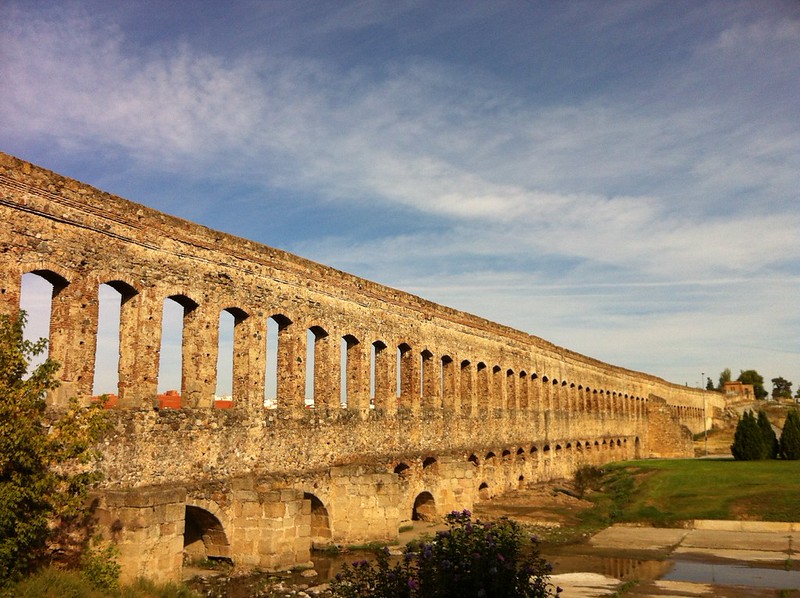
5. Acueducto de los Milagros (Miracles Aqueduct)
This striking row of towering brick-and-granite pillars once brought fresh water into the ancient Roman city from a nearby reservoir. The surviving arches soar 25 metres high in a tranquil green valley park. White storks frequently build massive, iconic nests right on top of the ancient stone pillars.
6. The Roman Circus of Mérida (Circo Romano) is one of the largest and best-preserved ancient chariot racing arenas in the world. Modelled directly after the famous Circus Maximus in Rome, it was built around 20 BC and could hold up to 30,000 spectators.
The arena track stretches 440 metres long and 115 metres wide.Visitors can see the foundations of the central median strip around which chariots furiously raced.
Structures like the Porta Pompae (main entrance) and Porta Triumphalis (triumph gate) still stand.
It was the training ground for Gaius Appuleius Diocles, a legendary local charioteer who became the highest-paid athlete in ancient history.
Destination: Spain