London’s Top Ten Elizabethan Era Buildings
Elizabethan buildings in London, dating roughly from 1558 to 1603, are rare survivors, often characterized by timber-framing, large windows, and, by the late 16th century, the first influences of Renaissance design.
Key examples include the Middle Temple Hall (1570s), Staple Inn on High Holborn, and Eastbury Manor House. Queen Elizabeth’s Hunting Lodge (1543, refurbished 1589) is another notable, well-preserved timber structure.
Key Elizabethan Buildings and Sites in London
1.The Inns of Court in Holborn and Temple: Lincoln’s Inn, Middle Temple, Inner Temple and Gray’s Inn began life as guilds of lawyers in the 14th and 15th centuries. Middle Temple and Lincoln’s Inn both have gorgeous Tudor great halls. Middle Temple Hall (1570s)is one of the finest surviving examples of Elizabethan architecture in London, featuring a magnificent hammer-beam roof..Lincoln’s Inn Gatehouse (1517-1521), while technically early Tudor, remained a central landmark for legal education during the Elizabethan era.
2. Staple Inn (c. 1585): Located on High Holborn, its striking timber-framed facade survived the Great Fire of London, providing a rare glimpse of a 16th-century city street.
Staple Inn on High Holborn started life as a wool market in the 13th century. This beautiful façade was constructed in 1586 during the reign of Elizabeth I
In 1415 it became an Inn of Chancery, which was essentially a place where the lawyers, clerks and students of the Inns of Court nearby could work, meet and learn. Those that worked here were known as the Society of Staple Inn.
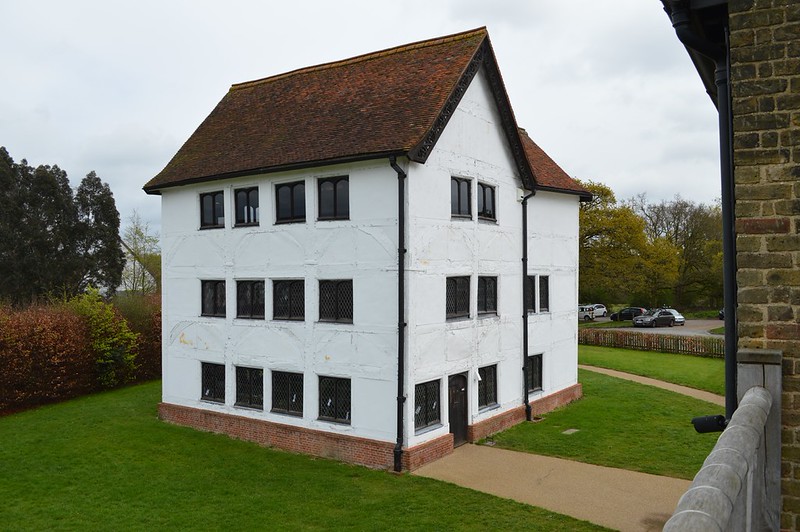
3. Queen Elizabeth’s Hunting Lodge (1589): A three-story timber-framed building in Epping Forest, refurbished during her reign, which now acts as a museum.
4. Eastbury Manor House (1556–1578): A red-brick, E-plan house in Barking, reflecting the gentry-class architecture of the era.
5.Charterhouse (1545/16th century): While founded earlier, the site was transformed into a luxurious Elizabethan mansion, frequented by the Queen.
6 The Tower of London: Served as a major prison, holding Elizabeth I herself in 1554 before her ascension to the throne.
7. Lambeth Palace Gatehouse (1490): Known as Morton’s Tower, it is a significant Tudor survival near the Lambeth Palace is the London home of the Archbishop of Canterbury and has been for nearly 800 years. It has been added to over the centuries and there are a couple of notable additions in the Tudor period. The impressive red brick gatehouse above is called Morton’s tower. Built in 1495, it was named for Cardinal John Morton, who was Archbishop at the time. He is known to have held audiences in the large room over the gate you can see in the photo.
8. St Bartholomew’s Gatehouse: Built in 1595 on top of a 13th century medieval arch that originally formed part of the Southern nave of the Church of St Bartholomew the Great behind. The dissolution of the monasteries in 1536 drastically reduced the church in size, freeing up more land and opportunities for residential buildings.
Shockingly, this beautiful facade was covered up in the Georgian period. It was only rediscovered when a bomb from a zeppelin raid in 1917 exposed the Tudor delight underneath. If you visit, make sure you have a look out for the statue of Henry VIII over one of the entrances to St Bart’s hospital- the only outdoor statue of Henry VIII in the city.
9. St James’s Palace: Was built by Henry VIII in the 1530s and was a residence of the King’s and Queen’s of England up until the reign of Queen Victoria. Since then it has been used for state visits and royal occasions.
It is a great example of red-brick Tudor architecture and was the setting for many important events. For example, Queen Elizabeth I was staying here whilst the country was under the threat of the Spanish Armada. She set out from here to Tilbury to make her famous speech to the troops assembled there.
10. St John’s Gate in Clerkenwell was built in 1504, during the reign of Henry VII, as the South entrance to the Clerkenwell Priory. This was the English headquarters of the Knights of the Order of St John or Knights Hospitaller. The monastery was dissolved by Henry VIII during the dissolution of the monasteries and the lands were doled out to favoured noblemen.
This gate is the only surviving fragment of the monastery and has had a variety of uses since. It was used as a printing house for the pioneering ‘ The Gentleman’s Magazine’ and workplace of Dr Samuel Johnson, who worked there as a writer. It was also the childhood home of artist William Hogarth from 1701-1709. His father opened a coffee house there called ‘Hogarth’s Coffee House’. The building was extensively restored in the Victorian period and, in true Victorian fashion, more medieval style features, such as the crenellations, were added.
Two Reconstructed Elizabethan Sites are among London ‘s popular tourist attractions
Shakespeare’s Globe: A reconstruction on Bankside that offers a glimpse into the architecture of 16th-century playhouses like the original Globe (1599).
The Golden Hind: A replica of the ship Sir Francis Drake used to circumnavigate the globe (1577-1580), docked in St. Mary Overie Dock.
Destination: England